
Did That Meeting Need to Be 4 Hours? How Post-Meeting Surveys Stop Boardroom Time-Wasting
It’s a familiar feeling for many Corporate Secretaries and chairs when the meeting ends, the room clears out (or the screen goes black), and they are left wondering, “Did we actually make any decisions today, or did we just read slides at one another?” If your directors leave the boardroom feeling like their time was wasted, frustration builds, engagement drops, and critical oversights happen. Implementing post-meeting surveys can significantly enhance meeting productivity and ensure valuable time isn't squandered.
After implementing post-meeting surveys over the past six months in our organization, we saw a 23% improvement in meeting efficiency, with directors reporting increased satisfaction and engagement. This underscores the vital role of real-time feedback loops in refining the boardroom experience.
The Problem with the "Annual" Checkup
Most boards rely strictly on an annual effectiveness evaluation. While necessary, relying only on a yearly review to catch bad meeting habits is like checking a ship’s navigation system only once a year—by the time you realize you're off course, you're already miles from where you intended to be.
The Business Case for Meeting Surveys
-
Cost visibility: Meetings compound silently. A survey makes their cost-benefit visible.
-
According to a 2026 industry report by McKinsey, ineffective meetings cost companies an estimated $399 billion annually in lost productivity.
-
Calendar reclamation: Teams that survey their recurring meetings regularly kill many of them within a year. In 2023, Shopify cancelled 12,000 recurring meetings and delivered 25% more projects. Reclaimed time compounds.
-
Facilitator learning: Most Chairs and Corporate Secretaries receive little or irrelevant feedback on their meetings. A survey provides them input they would not receive in any other way.
-
Stopping Drift: Recurring meetings can drift, and what started as a useful thing becomes a ritual. Periodic surveys catch the drift.
Which Meetings Deserve a Survey
Key Insights
Surveying every meeting is worse than surveying none. It creates exhausting work without producing a signal. The right approach is to survey selectively, focusing on the meetings where survey data can shape meeting decisions.
Meetings that deserve a periodic survey:
-
Weekly recurring committee meetings. Survey every 4 to 6 weeks to catch drift.
-
Quarterly business reviews. Survey every time to measure usefulness for decision-making.
-
Major project kickoffs and retrospectives. Survey every time. These meetings set or reset direction.
-
Training and onboarding sessions. Survey every time, using tailored training survey questions.
Meetings that should not be surveyed:
-
Social meetings. Satisfaction data here is noise.
-
One-off meetings. Too little context.
-
Emergency or crisis meetings. Too little context.
If the meeting occurs multiple times and runs longer than 30 minutes, a periodic survey should be conducted.
The 4 Golden Rules of Post-Meeting Surveys
To get busy directors to fill out a survey right after an exhausting session, you must follow four strict operational rules:
-
Keep it Short: The survey should rarely exceed 4 to 5 questions. The 3-question pulse is almost always the right starting point. Only escalate to the full survey for major reviews.
-
Keep it Fresh: The best post-meeting surveys arrive while the meeting is still fresh. Send it digitally via your board portal within 24 hours after adjournment.
-
Keep it Anonymous: Ensure individual responses are aggregated so directors feel safe pointing out inefficiencies or calling out dominated discussions. Attributed responses can feel like a report card.
-
Turn Feedback into Action: Visible change is what keeps response rates high. Share a summary of the survey data with the Chair before planning the next meeting, using the feedback to dynamically reshape future agendas. At the start of the next meeting, the Chair should verbally acknowledge the survey feedback and explicitly state changes that have been made as a result of this feedback. Cancel the meetings that are consistently rated as low-value, signaling to the team that the survey matters. Collecting data is pointless if you don't use it.
Common Mistakes
Important Considerations
-
Surveying every meeting creates fatigue, kills response rates, and produces noise.
-
Asking too many questions. Use the 3-minute pulse by default.
-
Asking "was it good?" without asking "how could it be better?" The improvement question is where the value lives.
-
Using only attributed surveys. Many meetings need anonymity to get honest answers.
-
Treating negative ratings as personal attacks. Post meeting data is feedback on the meeting, not the facilitator.
-
Not acting on results; two cycles of ignored feedback kills the program.
Essential Questions to Ask After Every Meeting
Skip vague questions like "Did you enjoy the meeting?" Instead, use targeted metrics that measure time efficiency, preparation quality, and strategic focus.
-
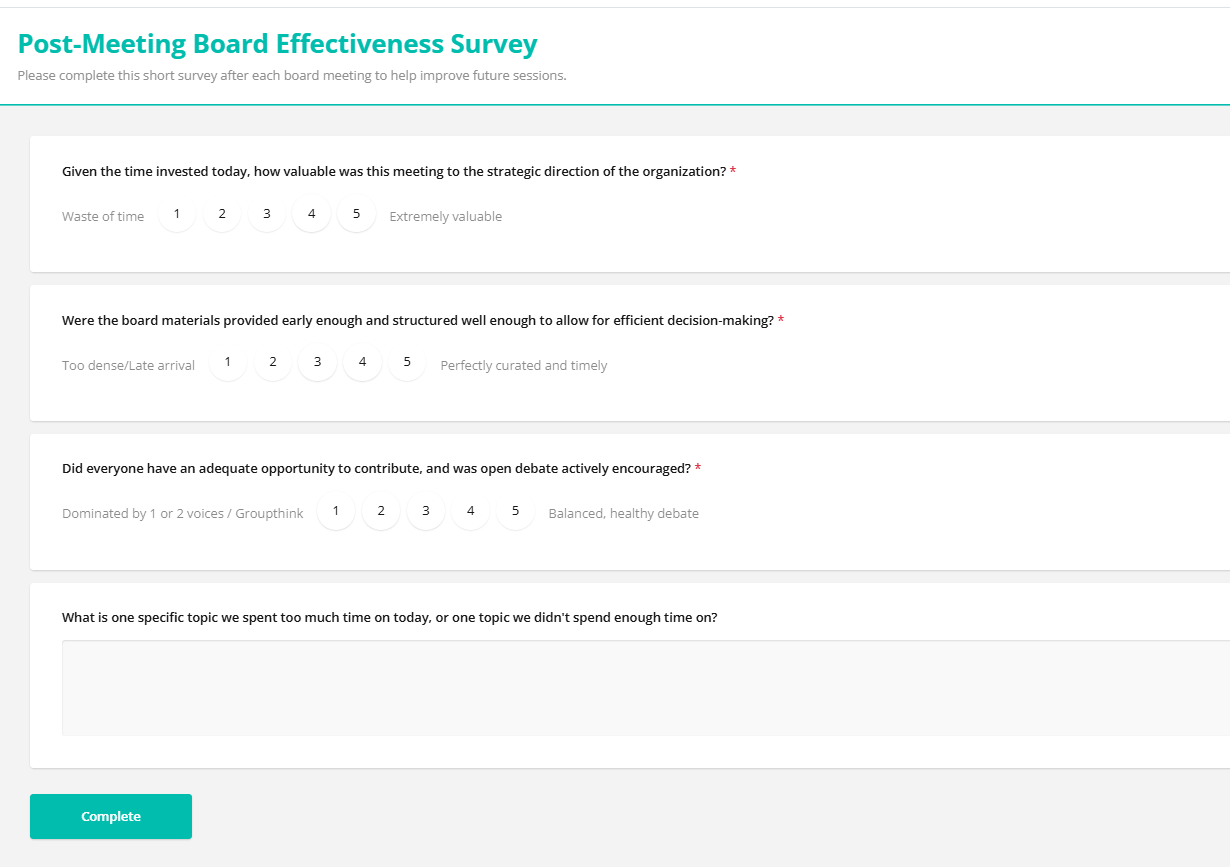
The ROI Question (Time vs. Value): "Given the time invested today, how valuable was this meeting to the strategic direction of the organization?" Scale: 1 (Waste of time) to 5 (Extremely valuable). Why it matters: This directly measures whether directors felt they did meaningful governance work or were just acting as an operational rubber stamp.
-
The Preparation Metric (The Board Pack Check): "Were the board materials provided early enough and structured well enough to allow for efficient decision-making?" Scale: 1 (Too dense/Late arrival) to 5 (Perfectly curated and timely). Why it matters: If the score is consistently low, it indicates that management is over-indexing on raw data dumps instead of high-level executive summaries.
-
The Room Dynamics Check (Groupthink & Dominance): "Did everyone have an adequate opportunity to contribute, and was open debate actively encouraged?" Scale: 1 (Dominated by 1 or 2 voices / Groupthink) to 5 (Balanced, healthy debate). Why it matters: This flags cultural friction early. If a specific executive or director is hijacking the agenda, the Chair needs to know.
-
The Actionable Takeaway (The Free-Text Box): "What is one specific topic we spent too much time on today, or one topic we didn't spend enough time on?" Format: Open text. Why it matters: Directors say what the rating scales can't capture. This tells the Corporate Secretary exactly how to alter the agenda weights for the next session.
Beyond the Essentials
While the core metrics cover the basics, your surveys should adapt to the nature of the meeting. Depending on the nature of the session, you may want to include targeted questions to evaluate guest speakers or assess committee-specific dynamics.
To get the most out of your feedback, utilize a blend of quantitative and qualitative questions:
-
Closed-ended questions produce clean, quantifiable data that is easy to track and compare over time.
-
Open-ended questions are your best tool for diving deeper, allowing team members to highlight unexpected bottlenecks and offer creative solutions that numbers alone might miss.
Streamlining Feedback with BoardCloud
You may believe you ticked off all the boxes during your presentation, but without continuous feedback, it is impossible to know if your meetings are truly hitting home.
BoardCloud’s integrated forms and survey feature eliminates the friction of post-meeting evaluations. Built directly into your secure portal environment, BoardCloud makes it easy to deploy completely anonymous questionnaires immediately following adjournment without resorting to e-mails or PDFs. With the built-in flexibility to customize your questions, metrics, and automatically collate responses, Corporate Secretaries and Chairs can instantly access actionable insights, ensuring your next boardroom session is a strategic success.
Key Takeaways
-
Cost visibility: Meetings compound silently. A survey makes their cost-benefit visible.
-
Asana's 2024 State of Work Innovation report found that executives waste 5.3 hours per week in unnecessary meetings.
-
Facilitator learning: Most Chairs and Corporate Secretaries receive little or irrelevant feedback on their meetings. A survey provides them input they would not receive in any other way.
-
Stopping Drift: Recurring meetings can drift, and what started as a useful thing becomes a ritual. Periodic surveys catch the drift.
-
Weekly recurring committee meetings: Survey every 4 to 6 weeks to catch drift.
Last updated: June 24, 2026