
Mastering Robert's Rules of Order: A Complete Guide to Effective Board Governance
Robert's Rules of Order provide the procedural foundation that separates productive board meetings from ones that drift, stall, or leave members frustrated. Originally published in 1876 by Henry Martyn Robert, these parliamentary guidelines have become the standard framework for how nonprofit boards, corporate committees, and civic organizations conduct business—governing everything from how a motion is introduced to how a vote is recorded and documented.
This guide walks through the core components of Robert's Rules in plain language, with practical context drawn from governance research. Whether your board is adopting these procedures for the first time or looking to apply them more consistently, the sections below cover the essential elements: structuring an agenda, establishing quorum, making and amending motions, facilitating debate, conducting votes, and maintaining accurate minutes. Each element reinforces the same underlying principle—that well-run meetings protect every member's voice while keeping the board focused on decisions that matter.
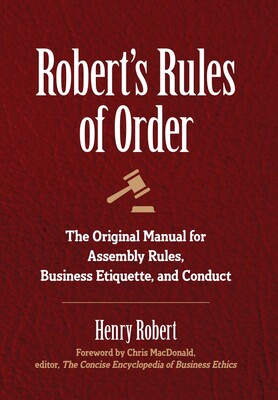
At its core, Robert's Rules of Order exist to promote fairness, order, and efficiency in group decision-making—ensuring that every board member has a genuine opportunity to contribute and that decisions are reached with transparency and structure.
Robert's Rules of Order can be defined as a standardized set of parliamentary procedures, first published in 1876 by Henry Martyn Robert, that govern how meetings are run, how proposals are debated, and how decisions are formally adopted. The rules have since become the standard reference for parliamentary procedure used by nonprofit boards, corporate committees, and civic organizations nationwide.
Understanding these rules matters more than ever. Research from BoardSource's long-running Leading with Intent survey — the only national study gathering input from both nonprofit board chairs and chief executives on their boardroom experiences — found that 67 percent of executives report their board doesn't spend enough time building relationships within the community the organization serves, a gap that often traces back to poorly structured meetings rather than a lack of goodwill.
1. The Order of Business
The order of business refers to the standard, repeating sequence in which categories of activity occur at every meeting, regardless of what specific topics are being discussed that day. It is often confused with the agenda, which is defined as the list of specific topics scheduled for discussion at a particular meeting and which can change from one session to the next.
1.1 Typical Order of Business
Robert's Rules of Order establish a standard sequence for conducting board meetings, and the typical order of business reflects that structure. Following this sequence consistently helps ensure that no category of business is overlooked and that members know what to expect at every session:
-
Calling the meeting to order — the formal declaration by the chair that the meeting has officially begun and business may proceed
-
Attendance / roll call
-
Approval of previous meeting minutes
-
Reports from officers
-
Committee reports
-
Unfinished business — items carried over from a previous meeting that were not fully resolved
-
New business
-
Adjournment — the formal closing of the meeting
Robert's Rules treat this sequence as the default framework, though boards may adapt it within their bylaws to reflect their specific needs.
1.2 Common Agenda Problems
A predictable order of business is one of the simplest tools for avoiding the pitfalls described in governance research. According to a chapter on board meetings from Milne Publishing's open governance text, boards struggling with meeting effectiveness often experience:
-
Agendas arriving too late for members to prepare
-
Agendas overloaded with routine items that crowd out substantive discussion
-
Important topics pushed to the end of the meeting, when energy has already faded
2. Quorum and Why It Matters
A quorum is defined as the minimum number of voting members who must be present for a board to have the legal and procedural authority to conduct official business and take binding votes.
-
The specific threshold is usually defined in the organization's bylaws — the internal governing document that sets out an organization's rules and procedures
-
Absent a bylaw provision, Robert's Rules defaults to a simple majority, meaning more than half of the voting membership
Quorum problems are tied closely to attendance. The National Council of Nonprofits notes that:
-
Meetings that leave board members feeling their time was wasted tend to drain energy and lower morale
-
Well-run meetings leave participants feeling focused and energized
This dynamic directly affects whether members show up consistently enough to sustain quorum over time.
3. Distributing the Agenda
For a meeting to run smoothly, the agenda needs to reach board members well in advance. The BoardEffect governance platform recommends that boards periodically revisit how their agendas are structured, noting that if a board repeatedly struggles to get through its agenda, that's a signal the organization may need:
-
More frequent meetings, or
-
A restructured agenda format
The chairperson — the presiding officer responsible for running the meeting according to procedure — carries primary responsibility for allotting realistic time to each item.
4. Making and Handling Motions
A motion is defined as a formal proposal put forward by a board member asking the group to take a specific action or adopt a specific position.
4.1 Steps for a Motion to Proceed
-
The motion is made by a member
-
It must be seconded — meaning at least one other member formally signals support for bringing it to discussion
-
The chair restates the motion clearly
-
The board discusses the motion
-
The chair calls for a vote once debate concludes
This sequence prevents boards from spending time on proposals that lack even minimal support.
5. Facilitating Debate and Discussion
Debate refers to the structured discussion period during which members speak for or against a motion before a vote is taken.
5.1 Rules of Debate
-
Members may speak only once recognized by the chair
-
Comments should be directed to the chairperson rather than to other members directly
-
Debate should stay focused on the motion at hand, avoiding personal attacks or irrelevant tangents
5.2 What the Research Shows
Research published in Nonprofit and Voluntary Sector Quarterly by Stijn Van Puyvelde, William A. Brown, Vernetta Walker, and Rosemary Tenuta examined how boardroom interactions relate to perceived board effectiveness. The authors found that interactions within the boardroom are generally and positively associated with both board chairs' and chief executives' perceptions of how effective the board is.
A separate observational study of nonprofit sport organization boards — drawing on 36 meeting observations, 18 interviews, and more than 900 supporting documents — similarly found that board members showed varying levels of engagement in decision-making, with chief executives and board chairs typically the most engaged participants. This underscores how much the chair's facilitation style shapes whether the rest of the board actually participates in debate.
6. Conducting Voting Procedures
Voting refers to the formal process by which board members express support or opposition to a motion, with the outcome determining whether the proposal is adopted.
6.1 Chair's Responsibilities During a Vote
-
State voting options plainly: "in favor," "opposed," "abstain" (the last referring to a member's choice not to vote either way)
-
Announce results immediately
-
Ensure votes are recorded accurately, especially for formal decisions
6.2 Voting Methods
|
Method |
Description |
Common Use |
|---|---|---|
|
Voice vote |
Members respond verbally |
Routine motions |
|
Show of hands |
Members raise hands to indicate position |
Simple counts |
|
Ballot vote |
Choices submitted in writing or anonymously |
Sensitive matters, e.g., personnel decisions |
|
Roll call |
Each member's vote recorded individually by name |
High-stakes or legally significant decisions |
7. Amendments to Motions
An amendment is defined as a formal proposal to alter the wording, scope, or substance of a motion that is already under consideration.
7.1 Requirements for an Amendment Must be seconded Must be discussed and voted on before the board returns to the original motion
This layered process lets boards refine proposals collaboratively rather than facing an all-or-nothing choice.
8. Points of Order and Meeting Conduct
A point of order refers to a formal objection raised by any member when they believe established meeting procedures are not being correctly followed.
-
Any member can raise a point of order at any time procedure appears to be violated
-
The chair must rule promptly on the objection
-
This restores order and reinforces that the rules apply equally to everyone, including the chair
9. Executive Sessions
An executive session is defined as a closed portion of a board meeting, attended only by board members and specifically invited participants, that is reserved for confidential or sensitive matters.
9.1 Common Uses of Executive Session
-
Legal disputes
-
Executive performance evaluations
-
Other sensitive personnel or organizational matters
Because these sessions limit transparency, the rules governing when they can be called should be clearly spelled out in the organization's bylaws.
10. Documenting Meeting Minutes
Minutes are defined as the official written record of what occurred during a meeting, including discussions, motions, and decisions. They matter for both accountability and legal compliance.
10.1 What Minutes Should Include Date, time, and location of the meeting
-
Names of attendees and absentees
-
Summary of reports and discussions
-
All motions, including who proposed and seconded them
-
Voting outcomes and decisions made
10.2 Timing
Minutes should be:
-
Drafted promptly after the meeting, while details are fresh
-
Circulated to members for review
-
Formally approved at the start of the next meeting
11. The Governance Gap: Why Structure Still Matters
Despite the clear logic behind structured meeting practices, sector-wide data suggests many boards still fall short.
11.1 Succession Planning
Succession planning is defined as a documented strategy for transitioning leadership roles, particularly the chief executive position. BoardSource's research found that, as of 2017:
-
Only 27 percent of nonprofits had a written succession plan for the chief executive position
-
Just 46 percent of CEOs described themselves as extremely satisfied in their roles
When the Community Foundation of Greater Atlanta uncovered comparable succession planning gaps among its regional nonprofits, it partnered with BoardSource on a cohort program called Embrace the Future. As a result, 100 percent of participating organizations developed a formal succession plan policy — a concrete illustration of how adopting structured governance practices translates into measurable improvement.
11.2 Board Composition
BoardSource's Leading with Intent findings have shown that:
-
Only 32 percent of boards place a high priority on knowledge of the community served when recruiting new members
-
Just 28 percent prioritize membership within that community
-
Nearly half of chief executives say their boards lack the right composition to build community trust
On the encouraging side, the same research line has tracked growth in board civic engagement: the share of board members educating policymakers on their organization's behalf rose from 33 percent in 2015 to 52 percent in 2017.
11.3 Academic Findings on Best Practices
A study using self-assessment data from 156 nonprofits, published in the Journal of Public and Nonprofit Affairs, tested several widely recommended governance practices and found that some practices were considerably more effective than others at improving perceived board performance. Notably, board members and chief executives sometimes disagreed about how well the board was actually doing — a reminder that procedural rigor like Robert's Rules provides a shared, objective reference point that reduces this kind of perception gap.
12. Structure Empowers Productivity
Robert's Rules of Order can feel formal, even rigid, to newcomers. But their underlying purpose is the opposite of bureaucratic obstruction — they exist to foster inclusive, transparent, and genuinely productive board meetings.
The evidence from BoardSource, Van Puyvelde and colleagues, and other governance researchers points to the same conclusion from different angles: boards that adopt consistent, well-understood procedures tend to report:
-
Higher perceived effectiveness
-
Stronger member engagement
-
More confidence that decisions carry legitimacy
When applied consistently, Robert's Rules supports effective governance, reduces unnecessary conflict, and helps a board fulfill its oversight responsibilities with clarity and professionalism.
Key Takeaways: Mastering Robert's Rules of Order
1. Structure Drives Productivity and Trust
-
Procedural Safeguards: Robert's Rules of Order provide an objective framework that ensures fairness, protects minority voices, and maintains order. Consistent structure prevents meetings from stalling, drifting, or being dominated by a few individuals.
-
Perception Gaps: Research shows board chairs, chief executives, and general members often perceive board effectiveness differently. Procedural rigor acts as a neutral, shared reference point that aligns everyone's expectations.
2. Standardizing the Order of Business
-
Sequence vs. Agenda: The order of business is the predictable, repeating sequence of categories (e.g., call to order, minutes approval, unfinished business, new business). The agenda is the fluid list of specific topics populated within that sequence.
-
Proactive Distribution: Agendas must be sent well in advance. Overloaded agendas or pushing major topics to the end drains energy and creates governance bottlenecks.
3. Procedural Guardrails: Quorum, Motions, and Debate
-
The Power of Quorum: A quorum (typically a simple majority unless defined otherwise in bylaws) is legally required to conduct binding votes. Poorly run meetings hurt attendance, which directly threatens an organization's ability to maintain a quorum.
-
The Lifecycle of a Motion: To protect a board's time, a motion must follow a strict path: it is made, seconded (showing baseline support), restated by the chair, debated, and voted on.
-
Structured Debate: Members must be recognized by the chair, direct all comments to the chair, and avoid personal attacks. Amendments must be voted on before returning to the main motion.
4. Voting and Accountability
-
Varying Voting Methods: Boards should match the voting method to the gravity of the decision—ranging from verbal voice votes for routine items to secret ballots for sensitive personnel matters, and individual roll calls for high-stakes decisions.
-
Meticulous Minutes: Minutes are the official legal and accountability record. They must be drafted promptly and accurately document the date, attendees, summaries of reports, exact motions, and voting outcomes.
5. Addressing the "Governance Gap"
-
The Engagement Paradox: Research indicates that board interactions positively correlate with perceived effectiveness, yet board chairs and CEOs typically dominate discussions. Chairs must deliberately use their facilitation style to invite broader participation.
-
Strategic Blind Spots: Sector data reveals widespread gaps in strategic governance; for instance, only 27% of nonprofits maintain a written succession plan, and many under-prioritize recruiting members from the communities they serve. Adopting structured processes helps boards pivot from routine administration to these critical, high-impact issues.
Sources
-
BoardSource, Leading with Intent: BoardSource Index of Nonprofit Board Practices
-
Van Puyvelde, S., Brown, W. A., Walker, V., & Tenuta, R. (2018). Board Effectiveness in Nonprofit Organizations: Do Interactions in the Boardroom Matter? Nonprofit and Voluntary Sector Quarterly
-
Journal of Public and Nonprofit Affairs, self-assessment study of 156 nonprofits
-
National Council of Nonprofits, "Effective Board Meetings for Good Governance"
-
BoardEffect, "How to Measure Nonprofit Board Effectiveness"
-
Milne Publishing, Guidelines for Improving the Effectiveness of Boards of Directors of Nonprofit Organizations, Chapter 7
Updated 30 June 2026

About the author
BoardCloud USA Editor
United States BoardCloud Editor.